
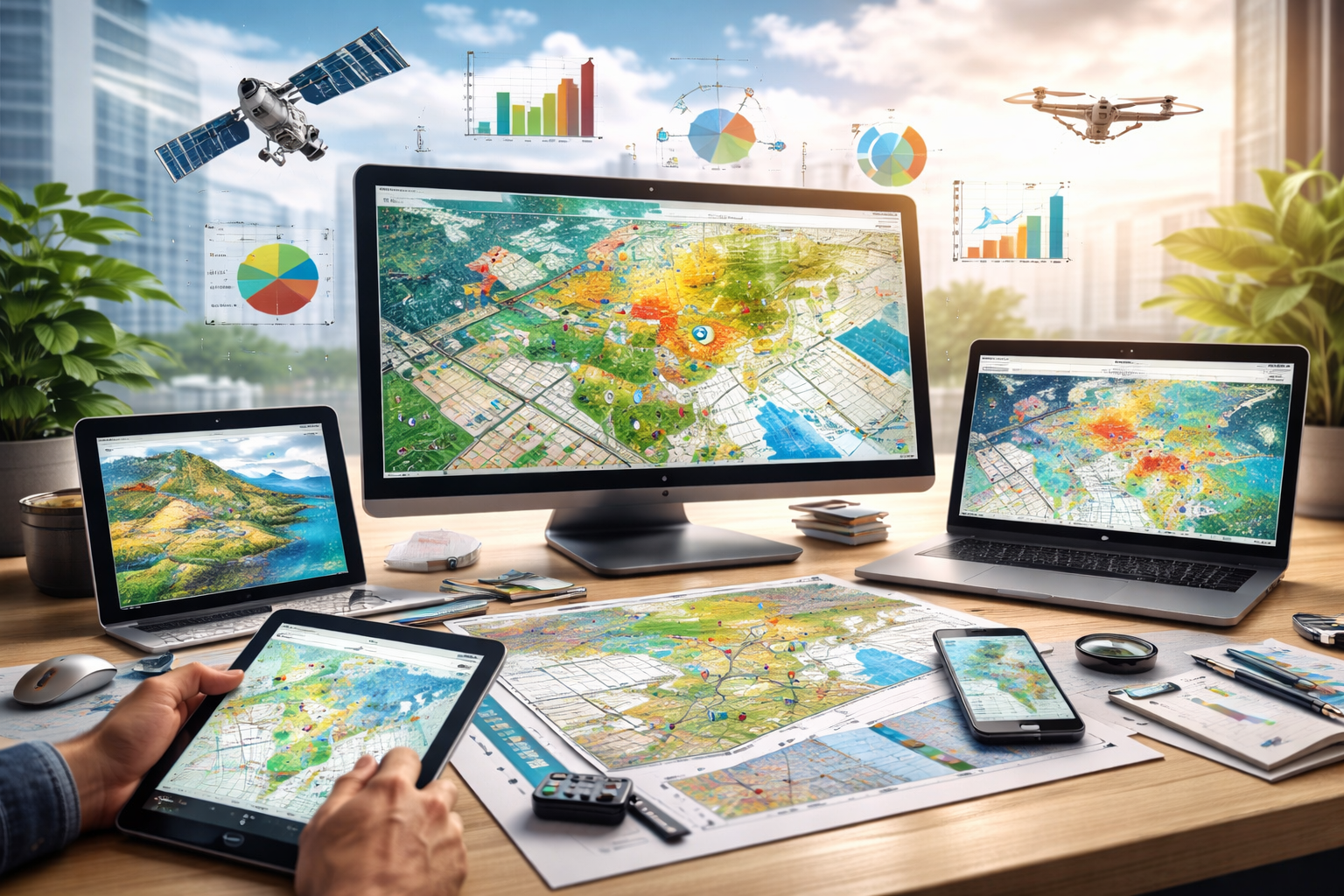

Geographic Information Systems (GIS) are computer-based tools that allow the collection, analysis, and visualization of spatial data. Their purpose is to connect maps with databases to solve problems related to planning, land management, and environmental analysis. Thanks to GIS, it is possible to visualize geographic phenomena on digital maps and perform interactive queries that facilitate decision-making in sectors such as urban planning, environment, transportation, and geomarketing.
What is a Geographic Information System?
A GIS is an integrated system of data, hardware, software, and human resources that works with spatial information related to the Earth. It functions as a geographic database that links alphanumeric attributes with objects on a digital map. By selecting an object, its characteristics can be identified, and by querying a record, its location can be determined on the map.
Types of Data in GIS
The vector model represents reality using points, lines, and polygons. It is ideal for modeling qualitative aspects and elements that require topological properties, such as transportation networks or administrative boundaries.
The raster model represents space through cells or pixels. It is faster and more efficient for analyzing continuous phenomena such as population density or land use. Both approaches offer different advantages depending on the type of geographic analysis required.
Main Functions of GIS
- Storage and management: Collect, verify, and update spatial data.
- Spatial analysis: Relate geographic information to identify patterns and trends.
- Visualization: Display results on digital maps, web environments, and mobile devices.
- Interactive querying: Enable fast and accurate searches based on attributes and locations.
Applications of GIS
GIS has multiple applications across various sectors:
- Environment: Evaluating environmental impact in reforestation, irrigation, and ecosystem conservation projects.
- Natural resources: Supporting geological analysis and mineral exploration.
- Cartography: Creating urban, architectural, and municipal maps for accurate territorial planning.
- Transportation: Developing traffic models, planning routes, and designing efficient mobility systems.
- Geomarketing: Identifying potential customer areas and performing strategic market analysis to optimize business decisions.
Examples of Use in Latin America
- GIS Argentina: National management of geographic and satellite data.
- GeoInfoMex (Mexico): Platform for thematic layers and territorial analysis.
- SIGSA Info: Tools for digital cartography and urban planning.
FAQs
1. What is a Geographic Information System?
It is software that integrates maps and databases to analyze spatial information.
2. What is the difference between GIS and other graphic software?
GIS is a spatial database that allows advanced analysis of geographic phenomena.
3. What types of data does GIS handle?
Vector (points, lines, polygons) and raster (cells or pixels).
4. What are the most common applications of GIS?
Environment, cartography, transportation, geomarketing, and natural resources.
5. What software is used in GIS?
ArcGIS, QGIS, ERDAS Imagine, and AutoCAD with georeferencing capabilities.
6. Which sectors demand GIS specialists?
Governments, private companies, universities, defense, and telecommunications.
7. What is a vector model in GIS?
It represents reality using basic geometries such as points, lines, and polygons.
8. What is a raster model in GIS?
It represents reality using a grid of cells that store attributes.
Conclusion
Geographic Information Systems (GIS) are essential tools for understanding and managing physical space. Their ability to integrate, analyze, and visualize data on digital maps makes them strategic solutions for governments, businesses, and universities. From urban planning to geomarketing, GIS provides practical and efficient solutions to address modern-world challenges.
Explore insightful articles, creative voices, and meaningful content at Passage Magazine.